A "cleaner anger"?
From someone who is generally allergic to being angry in public

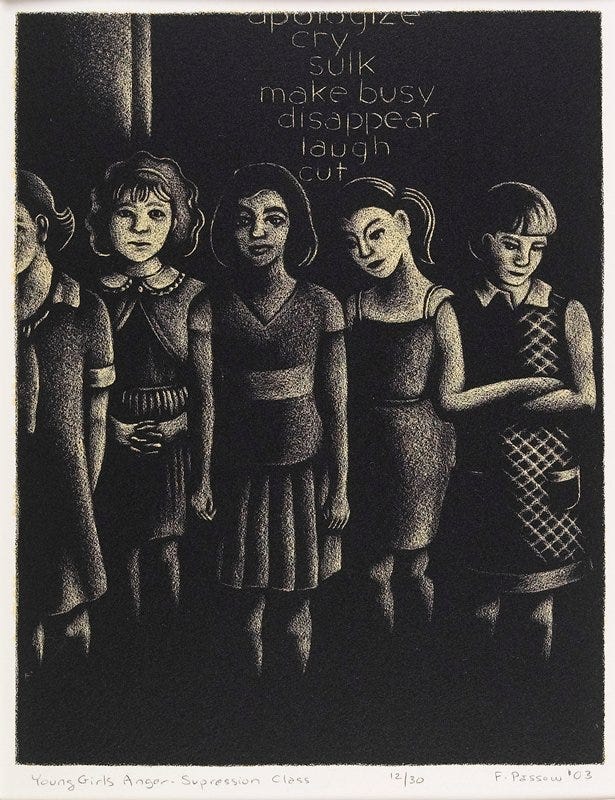
If emotions were people, anger would be my slightly awkward and embarrassing childhood friend: the one with whom I share an easy familiarity and fondness borne of long knowing, but who is odd and unwelcome in more grownup company — someone I love but am a little ashamed to be seen with in public. A beloved misfit that I hang out with a little apart, but can’t quite bring myself to own to the others in my life who I know would disapprove.
There are many reasons for this, probably, that I’m not too interested in analyzing.1 But one is that I am a Christian, and most Christians I know are not very good at anger.2 We all get angry, because we’re all human, but we’re weird about it: we pretend we can hustle past it quickly before the sun goes down; we press it down until it comes out sideways3; we spiritualize it by erecting a moral or biblical scaffolding, which props up and contains (and therefore makes more manageable) an otherwise raw rage.4 Anger is divisive, we’re told; it’s not constructive or particularly congruent with the fruit of the Spirit. Angry people are not winsome. They alienate others from the cause of Christ.5
So I get very nervous about showing anger in public. It feels unseemly, maybe even a little tacky, and I haven’t quite been able to figure out how this very real emotional companion fits with the character I hope is being formed in me: the character of a person whose life is hidden with Christ in God, who is no longer simply curved protectively in on herself but is called into a generous and loving openness to the world.6 If, as the old song goes, the fruit of the Spirit’s not a banana — well, it’s also not venom-laced prose or snarky asides.
There’s a chapter in my current book project7 that made me face this problem head on. It’s tentatively titled “Tell Me Why You Wear That Cross of Gold” and it’s a rumination on my evolving relationship to the cross, and all that it stands for, over time. (Come for the Michael W. Smith reference and stories of boys barking at me in 8th-grade homeroom, stay for what is essentially a Moltmann-Balthasar mashup theology of the cross. I do not know if anyone will read this book.) But the presenting issue that got me to sit down and start writing the chapter in the first place was the Mrs. White-level of rage that overtook me every time I spotted Karoline Leavitt or Pam Bondi sporting gigantic crosses in public. Whenever one of their photos showed up in my news feed, I wrote, “I want to rip it away…and insist, ‘That cross doesn’t belong to you. It belongs to me.’”8
This is not a very nice thing to say. I wrote, and rewrote, this chapter at least 10 times over. I told myself I wanted to get my theological thinking straight. But in fact what was tripping me up was that I could not figure out how to write my anger in public. To say “I’m mad!” out loud goes against just about every grain in my spiritual and intellectual makeup, for good reasons and bad.9 It took me way too many drafts as I felt my way towards exploring whatever truth this anger points towards, avoiding myopia and self-focus, and ultimately pointing a reader to something good and true rather than trying to recruit them to my side.
But I’m lucky to have very wise and very generous friends. One friend, in particular, is especially gifted at seeing below the surfaces of things and then naming them with precision and clarity. She’s a poet, too, which is no accident. I told her the story of my wrestling with this dumb chapter, which in the course of conversation brought to mind a funny Christmas ornament that my parents still have: when I was small, some Sunday school teacher thought it was a good idea to have a roomful of first-graders decorate large Styrofoam crosses with glitter and glue, and then pasted little photos of each child right in the center. Aesthetically, it’s very 1985-evangelical; theologically, it’s both wiser and more profound than this teacher probably guessed.10 There’s my little face, sitting right at the heart of the cross-beams, a parable for everything I’d been wrestling with. Saying “the cross belongs to me” from the vantage point of its embrace doesn’t dissipate my anger at women who don it like a team jersey, but I realized through the process of writing that it certainly changes that anger’s character, its flavor in my mouth. I just couldn’t quite name how.
In response, my friend passed on a phrase she had received from one of her wise friends: a cleaner anger. An anger that has been cleansed, she said, is an anger that has been held before God, handed over to God’s presence, and then received back in a clarified or filtered way. An anger — and these are my friend’s words — that is no longer “clotted and unclean” but has been somehow purified and is therefore safe to handle. It retains a sharp tang but has lost the bitterness. It’s the kind of anger that can look at my silly Styrofoam cross, at the women who wear crosses in public while serving a man who patently wants to imitate the Caesars who crucify, and at my own adulterated rage that wants to claim both cross and Crucified for myself, with the clarity that includes pity and sorrowing love because all of us, all the time, are turning our backs on the One who went there for us in the first place.
But — and here’s the thing — I still feel angry. A cleaner anger remains…anger. It is not collapsed into pity and love, but it is channeled and chiseled by both. Another wise friend once said to me that underneath anger, you’ll always find fear; look under the rock of fear, and what else is there but love? We so often unsheathe our claws because we’re defending something we cherish. But an anger shot through with fear is the clotted and choking kind. It draws hard lines, gets its target in its sights, and empties the clip. A frightened fury wants to neutralize the lethal threat before it can harm something I hold dear.
So what I wonder is whether a cleaner anger is one in which love has cast out fear? Can there be an anger that is love-shaped, which wishes only good for its object and so goes about its business accordingly? Is there such a thing as anger that is marked by hope rather than condemnation? That retains a keen sense that this thing I am seeing is wrong, but always with the rueful acknowledgement that the person doing it is always my crooked neighbor, who I have to love with my own also-crooked heart?11
I sure do hope so. I certainly experienced the “utterly torturous and uncommendable” (another helpful phrase from my poet/writer friend) process of writing that chapter as a kind of cleansing, and I hope that transformation is reflected on the page. Although, of course, the audience for a book whose primary influences are W.H. Auden, D.C. Talk, Hans Urs von Balthasar, Rebecca West, Amy Grant, Robert Farrar Capon and William Stringfellow is…vanishingly small? But I don’t really care. I got to learn something about anger, and how to offer it up and receive it back to hold, not drop like a hot potato or wield like an M-16. Audience aside, I’m grateful for the purifying fire.
If we were close friends and out for a drink, you could maybe get me to speculate on how anger did and did not show up in my family of origin, in my husband’s family of origin, and how that has been metabolized in our own little family’s life. No way am I doing that out here on main.
And yes, I do know that there is plenty of good preaching and writing out there about things like “in your anger, do not sin” (Eph 4:26); that there is a whole tradition of prophetic anger against injustice; and so on. Not all Christians are bad at anger. Granting that, what follows is my overwhelming experience with the Christians I know and love. Your mileage, of course, may vary.
Maybe this is just me, but: have you ever taken on a project or joined a committee full of what feels like righteous, reforming zeal — only to realize, as things unfold and run into the friction of other people and maybe don’t go the way you intended, that the real reason you jumped into this work was that you were just hopping mad about something and wanted to grab hold of it to refashion according to your will? No? Okay. But I told you: anger makes some of us weird.
This one crosses all kinds of longstanding theological divides. There are lots and lots of ways to say “It’s OKAY for me to be so mad at these people, because GOD certainly is too!”
This isn’t entirely wrong! Jesus and his church have not been well-served by the public performance of anger that has dominated online spaces for the past 15 years or so. But it’s also a move that is often deployed when anger makes us uncomfortable or feels threatening, primarily for the purpose of smoothing things over by telling the angry person to chill out already.
I’m Lutheran enough in my theological proclivities to acknowledge that this is not just a nice sentiment: the spine is forever snapping back into its curve, and the breaking-open to the world has to happen about a hundred times a day.
Yep, you heard that right! I’m enrolled in the Sacred Art of Writing D.Min cohort at Western Theological Seminary, and my genre writing project is part of what will eventually be a book-length series of essays organized around words that live at the heart of Christian faith. The book moves roughly chronologically, with each essay taking a close look at one word and how it functioned me for me at a particular stage in life and then turning it over and around to see what good news it still speaks: to people in the church who may find themselves bored, perplexed, or embarrassed by our old lexicon; and to people looking in from outside, who find the vocabulary of faith simply alien or even off-putting and ill-used by some of the louder public Christian voices in our culture. The essay I’m talking about here is about the word “cross.”
Even about three seconds’ worth of theological reflection, of course, reveals that this is a very dangerous thing to say. Peter, after all, wound up getting his wish of “owning” Jesus and his cross (Mk 14:29, Jn 21:18-19); when St Paul and the earliest martyrs extolled the “wisdom of the cross,” they did so knowing that landing on one remained a live option for them. And of course to say “mine, not yours” is a blatant refusal of the whole New Testament witness, starting with Jesus’ own declaration that “when I am lifted up, I will draw all people to myself” and continuing through Paul’s radical assertion that “just as in Adam all die, in Christ all will be made alive.” Barring someone from the cross is…anti-Christ? I wrestled with all of this as I wrote.
All the voices that tell girls not to be shrill or mean in public are in there, along with the spiritual scolds warning that anger is unbecoming and indecorous; those voices are accompanied by some wise ones reminding me that anger can be a deadly sin, who urge me to slow down, pray, reflect, listen, look for perspective. It’s noisy in my head when I write.
Or maybe not! Maybe I had some budding seminarian who had been reading a lot of Barth volunteering that Sunday. It was a Methodist church, so I doubt it, but who knows?
W.H. Auden, “As I Walked Out One Evening”
Came for the MichaelW, stayed for the HansVonB. Here for this book! My old pastor always used to preach that anger was an indication that something needed to change, within or without. I’m going to couple that with your “refined anger” and see what theology-babies they make.
Anything that draws on Rebecca West has my attention!